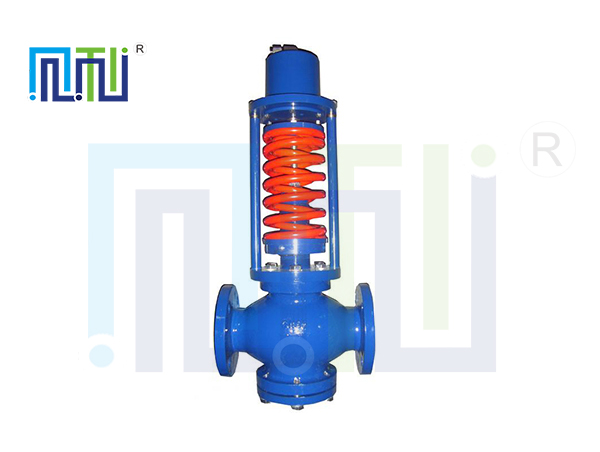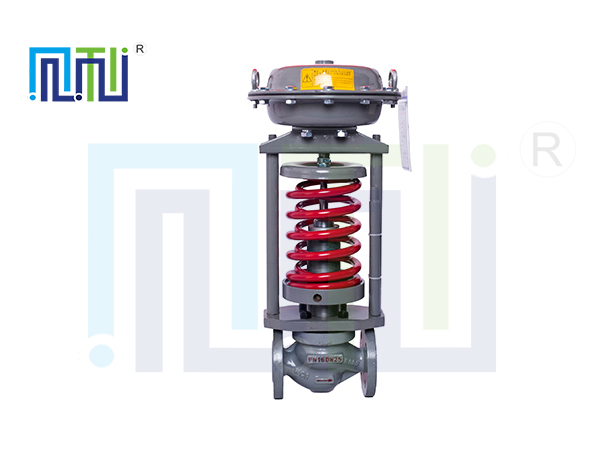
Self-reliant pressure regulating valves are divided into three series: self-reliant pressure, differential pressure and flow regulating valves. Self-reliant pressure regulating valve according to the position of the pressure point is divided into two categories: before the valve and after the valve. When the pressure point is in front of the valve, it is used for the constant pressure before the regulating valve; When the pressure point is behind the valve, it is used to regulate the constant pressure after the valve. When the pressure before and after the valve is introduced into both sides of the air chamber of the actuator at the same time, the self-controlled differential pressure regulator can adjust the constant pressure at both ends of the regulator, and can also be installed on the pipe orifice plate at both sides of the air chamber of the film actuator to form the self-controlled flow regulator, or by other means after the flow detection with self-controlled differential pressure regulator flow regulation.
Self-actuated pressure regulating valve is a kind of hydraulic balancing valve with automatic constant pressure difference, which is used in heating. In central air conditioning and other water systems, the control system supports the independent adjustment of each user end device to eliminate pipe network pressure.
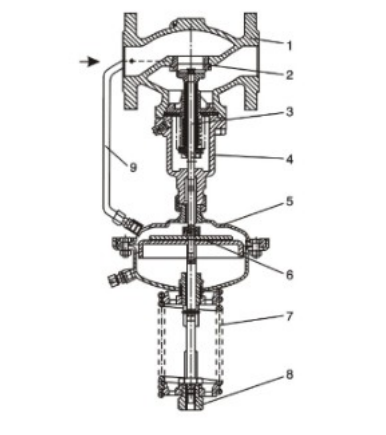
After the valve pressure P1 of the working medium is throttled after the spool and valve seat, it becomes the valve pressure P2. P2 is input into the lower membrane chamber of the actuator through the control pipeline and acts on the top plate. The generated force is balanced with the reaction force of the spring, which determines the relative position of the spool and seat and controls the pressure behind the valve.
When the pressure P2 behind the valve increases, the force P2 acts on the top plate also increases. At this point, the top plate's action is greater than the spring's reaction force, so that the valve core closed to the seat position, until the top plate's action and the spring's reaction force balance so far. At this time, the flow area of the spool and seat is reduced, and the flow resistance is increased, so that P2 is reduced to the set value. Similarly, when the pressure P2 after the valve is reduced, the direction of action is the opposite of the above, which is the working principle of self-reliant (after the valve) pressure regulator. This type of valve should generally be installed horizontally in the pipeline.
Adjust the adjusting nut when the set value of P2 behind the valve needs to be changed.
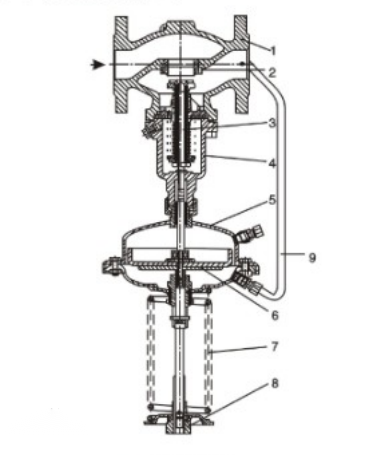
After the valve pressure P1 of the working medium is throttled after the spool and valve seat, it becomes the valve pressure P2. At the same time, P1 is input into the upper membrane chamber of the actuator through the control pipeline and acts on the top plate. The generated force is balanced with the reaction force of the spring, which determines the relative position of the spool and seat and controls the pressure before the valve.
When the pressure P1 in front of the valve increases, the force acting P1 on the top plate also increases. At this point, the top plate's force is greater than the spring's reaction, causing the spool to move away from the seat until the top plate's force is balanced by the spring's reaction. At this time, the flow area of the valve core and the valve seat increases, and the flow resistance becomes smaller, so that P1 is reduced to the set value. Similarly, when the pressure P1 in front of the valve is reduced, the direction of action is the opposite of the above, which is the working principle of the self-reliant (in front of the valve) pressure regulator.
1、Self-reliant pressure regulating valve without external energy, can work in no power and no gas occasions, both convenient and energy saving.
2、The pressure segment has a fine range and crosses each other, and the adjustment precision is high. The pressure segment has a fine range and crosses each other, and the adjustment precision is high.
3、Pressure setting values can be set continuously during operation.
4、To adjust the pressure after the valve, the ratio between the pressure before the valve and the pressure after the valve is 10:1~10:8
5、Rubber diaphragm type detection, actuator detection precision is high, sensitive action.
6、The pressure balancing mechanism is adopted to make the regulating valve responsive and accurate.
Nominal diameter:DN15-DN450mm
Nominal pressure:PN1.0、1.6、4.0、6.4MPa
Flange standard:ANSI、JIS、DIN、GB、JB(Special can be provided by user)
Valve body material:Cast steel(ZG230-450)、Cast stainless steel(ZG1Cr18Ni9Ti、ZG1Cr18Ni12Mo2Ti)
Spool material:Hard seal--Stainless steel(1Cr18Ni9Ti、1Cr18Ni12Mo2Ti);Soft seal--Stainless steel inlaid rubber ring
Pressure balance:Stainless steel bellows(DN15~125)、Balance diaphragm(DN150~250)
Main technical parameters and performance indicators
category | Model number | category | Model number |
Single seat compression type | ZZYP-16-64B | Single seat pressed open type | ZZYP-16-64K |
Double seat compression type | ZZYN-16-64B | Double seat press-open type | ZZYN-16-64K |
Telescopic type | ZZYM-16-64B | Sleeve pressed open type | ZZYM-16-64K |
3.1Pressure-closed type: used for valve pressure regulation, when the valve pressure rises, the valve is closed, in order to achieve the purpose of decompression, pressure regulation.
3.2Pressure open type: used for valve pressure regulation, when the valve pressure rises, the valve opens, in order to achieve the purpose of pressure relief, pressure regulation.
Direct action self-reliant pressure regulating valve is in no electricity, no air under the occasion, the use of the medium itself pressure change control valve (K type) or valve (B type) pressure of constant pressure or pressure reduction, equipped with a condenser, can be used continuously under 350 degrees Celsius steam, film type for less than or equal to 0.7mpa pressure, piston type for 0.7 ~ 2.5 MPa pressure, Widely used in petroleum, chemical, electric power, metallurgy, food, textile and other industrial equipment gas, liquid, steam medium decompression, pressure relief, pressure regulation.
1. Operation at room temperature when using gas or low viscosity liquid:
(1) Slow opening valve before and after the stop valve;
(2) Loosen the exhaust plug until the gas or liquid escapes from the actuator
(3) Then tighten the exhaust plug again, the regulating valve can work. The required pressure value can be obtained by adjusting the pressure regulating disc. When adjusting, pay attention to the marked value of pressure. The action is slow, and the valve stem must not rotate with it
2. Operation when steam is used:
(1) Unscrew the orifice screw from the condenser
(2) Loosen the actuator exhaust plug
(3) Use the drain head to add through the injection port until the exhaust hole is discharged
(4) Tighten the exhaust plug and continue filling water until it overflows the injection port
(5) Tighten the injection port screw
(6) Slowly open the regulator front and rear stop valves
(7) Adjust the pressure regulator and observe the pressure indication value until required.
After it is put into operation, the general maintenance work is little. At ordinary times, it is only necessary to observe whether the value of the pressure before and after the valve meets the requirements of the process. In addition, observe whether the stuffing box and actuator leakage, if leakage should be tightened or replaced packing and diaphragm.
Notice to quotation:
1、Valve body parameters: caliber, working pressure, valve body material, using medium, connection form and other parameters
2、Actuator: actuator form, control mode, control signal (4-20MA), mode of action (gas-open gas-close type)
3、Optional accessories: solenoid valve, limit switch, two couplings
Please try to provide details about the parameters of each standard electric valve, to facilitate our company's technical personnel for your accurate selection.